What is Shilajit?
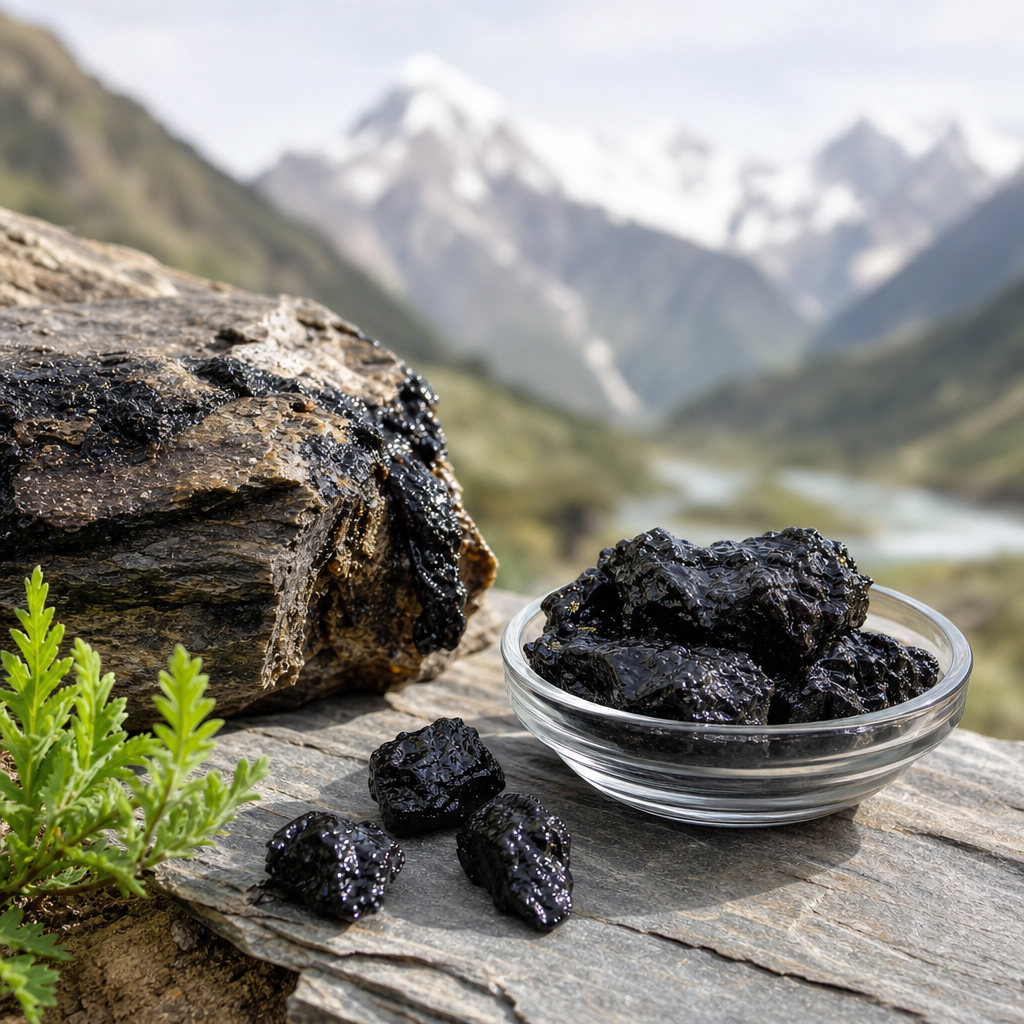
Shilajit is a tar-like, mineral-rich exudate that seeps from rocks in high mountain ranges such as the Himalayas, Altai, and Caucasus, formed over centuries from decomposed plant matter and microbial action. In traditional Ayurvedic medicine, it is considered a rasayana (rejuvenative) substance. Modern analyses show that purified shilajit contains fulvic acids and other humic substances, small amounts of dibenzo-α-pyrones (DBPs) and DBP–chromoproteins, trace minerals, and various organic compounds. It is typically used as a dietary supplement and is best categorized as a natural resinous extract rather than an essential nutrient.
Shilajit is not required by the body in the way vitamins, minerals, essential fatty acids, or essential amino acids are. Rather, it is taken for potential adaptogenic, antioxidant, and mitochondrial-support effects, as well as for possible support of male reproductive health and altitude adaptation. While laboratory and animal research offers mechanistic clues, human evidence remains limited for many claims, so expectations should be modest and products should be chosen carefully for quality and purity.
Benefits of Shilajit
-
Male reproductive health (testosterone and sperm parameters)
(Moderate evidence)
Shilajit has been studied in small randomized and open-label trials in men with subfertility or low-normal testosterone. Purified shilajit (often 250 mg twice daily) has been associated with improvements in total and free testosterone and in semen parameters such as sperm count and motility after 8–12 weeks. The number of studies is small and often involves specific populations (e.g., subfertile men), so findings may not generalize to healthy, eugonadal men.
-
Exercise performance and recovery
(Limited evidence)
Some small human studies suggest shilajit may modestly improve markers of exercise adaptation, reduce perceived fatigue, and influence mitochondrial function biomarkers. Findings are not consistent, sample sizes are small, and protocols vary, so performance effects should be considered tentative. It may be more relevant for recovery or training adaptations rather than acute performance boosts.
-
Altitude adaptation and fatigue at high elevation
(Limited evidence)
Traditional use and preliminary studies suggest shilajit may aid acclimatization, possibly through effects on energy metabolism, iron handling, and antioxidant capacity. However, high-quality, controlled human trials are scarce. It should not replace evidence-based altitude strategies like gradual ascent, hydration, and medical management when indicated.
-
Cognitive support and neuroprotection
(Preliminary evidence)
Fulvic acid and DBP-related compounds show antioxidant and potential anti-aggregation effects in laboratory models relevant to brain health. A few exploratory human studies suggest possible benefits for fatigue and mental performance, but robust clinical trials in specific cognitive disorders are lacking. Current evidence does not support using shilajit as a sole therapy for neurological conditions.
-
Metabolic and cardiovascular markers
(Mixed evidence)
Early research reports small improvements in lipids or glycemic markers in some groups, while other studies show no meaningful changes. Differences in dose, duration, product standardization, and participant health status likely explain the inconsistency. More rigorous trials are needed before drawing firm conclusions about cardiometabolic benefits.
-
Inflammation and antioxidant status
(Limited evidence)
Shilajit’s humic substances may modulate oxidative stress and inflammatory signaling in preclinical models. Limited human data indicate potential shifts in antioxidant enzyme activity or inflammatory markers, but clinical relevance remains uncertain. Benefits, if present, are likely modest and best paired with foundational lifestyle measures.
Types or Forms Available
-
Purified resin (traditional form):
A sticky, tar-like material that dissolves in warm water or milk. Reputable brands purify the resin to remove contaminants and standardize key constituents (often to a specific fulvic acid range). Resin allows flexible dosing but can be messy to measure accurately.
-
Capsules or tablets:
Dried or powdered purified shilajit delivered in fixed-dose units (e.g., 250–500 mg). These are convenient, help with consistency, and can be standardized to fulvic acid content. They are generally preferred for ease of use and accurate dosing.
-
Powders:
Spray-dried or freeze-dried purified shilajit. Powders are easy to mix into beverages and allow titration but should still be standardized and tested for contaminants.
-
Liquid drops/tinctures:
Solutions intended for sublingual or oral use. Absorption claims vary and are not well-validated; check for third-party testing and clear standardization.
-
Composite formulas:
Shilajit combined with adaptogens (e.g., ashwagandha), nitric oxide boosters, or men’s health blends. Blends can complicate dosing and make it hard to attribute effects; quality control varies widely.
Regardless of form, choose products labeled “purified,” standardized to a known fulvic acid range (commonly 15–20%), and accompanied by third-party testing for heavy metals (lead, arsenic, cadmium, mercury), microbial contaminants, benzo[a]pyrene, and adulterants. Avoid “raw” or unprocessed shilajit and products making sweeping disease-treatment claims.
How to Use Shilajit
-
Common dosage range:
Typical supplemental intakes are 200–500 mg per day of purified shilajit, often standardized to around 15–20% fulvic acids. Some studies have used 250 mg twice daily. Start at the lower end to assess tolerance. Avoid megadoses; higher amounts have not been proven more effective and may increase risk of side effects.
-
Best timing:
Morning or early afternoon is common. Some people report mild stimulation; if you experience this, avoid taking it late in the evening.
-
How to take it:
Take with water and, if sensitive, with a small meal to reduce potential gastrointestinal upset. Resin can be dissolved in warm water, milk, or a non-acidic beverage.
-
Consistency:
Potential benefits (e.g., reproductive markers, training adaptations) generally require consistent daily use for 8–12 weeks. Reassess need and response periodically with a healthcare professional.
Food Sources and Supplement Options
Shilajit is not naturally present in conventional foods. It is a mountain-derived resin formed from decomposed botanical matter and mineral interactions within rock strata. As such, it is primarily available as a dietary supplement rather than through diet.
Supplementation may make sense for individuals specifically targeting outcomes explored in preliminary studies (e.g., male reproductive parameters or high-altitude travel support), especially when food-based strategies do not address those goals. However, a food-first approach remains foundational for general health: whole foods supply essential nutrients, fiber, and phytochemicals that shilajit does not replace. Supplements can provide targeted dosing but should complement—not substitute—sound nutrition, sleep, training, and medical care when needed.
Who May Benefit from Shilajit?
-
Men with subfertility or low-normal testosterone under medical supervision who are exploring adjunctive, non-pharmacologic options.
-
Recreational or competitive athletes seeking small, potential improvements in training adaptation or recovery, recognizing the evidence is limited.
-
Individuals traveling to or living at high altitude who want adjunctive support alongside proven acclimatization strategies and medical guidance.
-
Adults interested in general vitality or energy support after addressing basics like sleep, nutrition, hydration, and iron/B12 status.
-
Older adults curious about healthy aging support, with realistic expectations and attention to medication interactions and medical conditions.
-
People looking for adaptogenic-style supplements but preferring mineral-rich, resinous extracts over herbs, understanding that data are still emerging.
Side Effects and Considerations
-
Quality and contamination risks:
Raw or poorly processed shilajit can contain heavy metals, mycotoxins, or PAHs. Choose purified, standardized products with third-party certificates of analysis verifying low heavy metals and microbial safety.
-
Gastrointestinal symptoms:
Nausea, upset stomach, or loose stools can occur, especially at higher doses or when taken on an empty stomach. Start low and take with food if sensitive.
-
Stimulation or sleep disturbance:
Some users report restlessness or insomnia. If this occurs, reduce dose or take earlier in the day.
-
Hormone-sensitive conditions:
Because some studies show increases in testosterone in men, individuals with hormone-sensitive conditions (e.g., prostate issues) should consult a clinician before use.
-
Kidney and liver considerations:
People with kidney or liver disease should avoid use unless a clinician approves and monitors it. Contaminants in substandard products may pose added risk.
-
Uric acid and gout:
There are reports of uric acid changes with humic substances; those with gout or a history of uric acid kidney stones should use caution and consider monitoring.
-
Blood sugar and blood pressure:
Limited research suggests possible small effects on metabolic parameters. If you take medications for diabetes or hypertension, monitor closely and consult your healthcare professional to avoid additive effects.
-
Medication interactions:
Robust interaction data are limited. Use extra caution if you take anticoagulants, antiplatelets, antihypertensives, antidiabetics, or hormone therapies. Discuss with a pharmacist or clinician.
-
Allergies and skin reactions:
Rarely, rash or hypersensitivity may occur. Discontinue if you experience allergic symptoms.
-
Pregnancy, breastfeeding, and children:
Safety data are insufficient. Avoid use unless a qualified healthcare professional specifically recommends it and monitors closely.
-
Pre-surgical use:
As with many supplements, discontinue 1–2 weeks before elective surgery unless your surgical team advises otherwise.
Common Myths About Shilajit
-
Myth: Shilajit is an essential nutrient that everyone needs daily.
Shilajit is not an essential vitamin or mineral. It is a non-essential resinous extract used as a supplement. The body does not require it for basic survival, and many claims remain under investigation.
-
Myth: Shilajit boosts testosterone for all men and enhances libido uniformly.
Small trials suggest benefits mainly in subfertile men or those with low-normal testosterone, not necessarily in healthy, eugonadal men. Responses vary, and it is not a guaranteed libido enhancer.
-
Myth: Raw, unprocessed shilajit is more “natural” and therefore better.
Raw shilajit can contain heavy metals, microbes, and harmful compounds. Proper purification and third-party testing are essential to reduce contamination and standardize active constituents.
-
Myth: Shilajit “detoxes” heavy metals from the body.
While humic substances can bind metals in lab settings, clinical evidence that shilajit safely removes heavy metals in humans is lacking. In fact, contaminated products can increase metal exposure risk.
Conclusion
Shilajit is a traditional, mineral-rich resin with modern interest for male reproductive health, training adaptation, and potential support during altitude exposure. Evidence for some outcomes—most notably male fertility parameters and low-normal testosterone—appears promising but not definitive. For other areas like cognition, cardiometabolic markers, and inflammation, data are early or mixed. If you choose to try shilajit, select a purified, standardized product with third-party testing, use conservative dosing, and evaluate response over 8–12 weeks.
People who are pregnant or breastfeeding, children, and those with medical conditions or taking medications should consult a qualified healthcare professional before use. Individuals with kidney or liver disease, gout, or hormone-sensitive conditions should be especially cautious. A food-first approach remains foundational for health; shilajit is not a substitute for balanced nutrition, sleep, stress management, or medical care. Consider supplementation as a targeted, adjunctive option when your goals align with the available evidence and safety considerations are addressed.