What is Holy Basil?
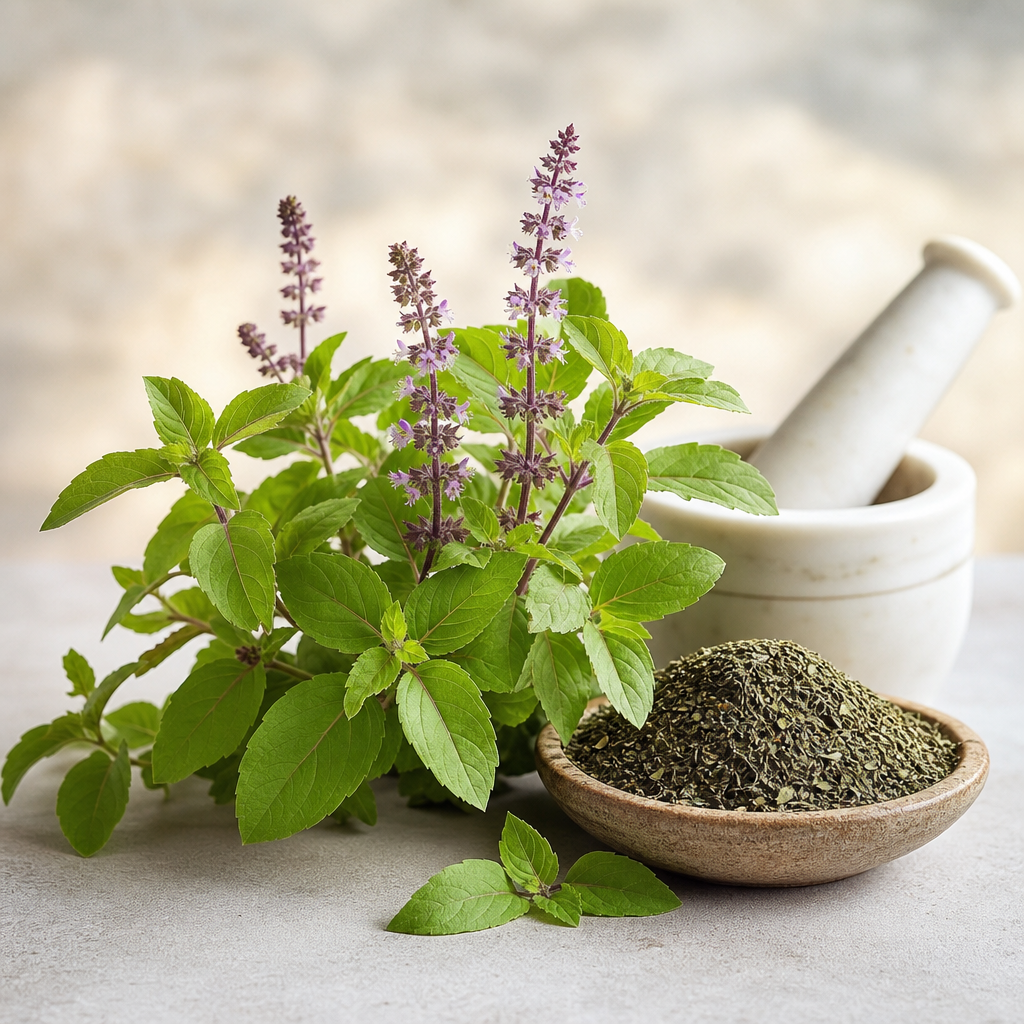
Holy basil (Ocimum tenuiflorum or Ocimum sanctum), commonly called tulsi, is a fragrant herb in the mint family long used in Ayurveda, India’s traditional system of medicine. There are several varieties—such as Rama (green leaves), Krishna (purple-tinged leaves), and Vana (a wild type)—that share a peppery, clove-like aroma. The leaves and aerial parts are most commonly used. Holy basil contains aromatic compounds and polyphenols, including eugenol, rosmarinic acid, ursolic acid, and unique constituents called ocimumosides, which are thought to contribute to its calming, adaptogenic profile.
In modern wellness, holy basil is considered an adaptogen—an herb that may help the body adapt to stressors and support balance. It is available as teas, powders, capsules, tinctures, and topical or aromatic essential oils. While many people use it to support stress resilience, mood, and everyday immune health, holy basil is not an essential nutrient. Unlike vitamins, minerals, essential fatty acids, or essential amino acids, the body does not require holy basil to function. Any benefits come from its bioactive plant compounds rather than from filling a physiological requirement.
People use holy basil as a culinary herb in some regions, but most evidence-informed uses rely on standardized extracts taken as dietary supplements. As with any botanical, quality and consistency vary, so choosing reputable products is important.
Benefits of Holy Basil
-
Stress resilience and mild anxiety support
(Moderate evidence)
Emerging human trials suggest that standardized holy basil extracts may reduce perceived stress and tense mood in otherwise healthy adults. Several small randomized studies have found improvements in self-reported stress, worry, and sleep quality compared with placebo after a few weeks of daily use. Proposed mechanisms include modulation of the stress response, antioxidant activity in neural tissue, and support for neurotransmitter balance. Effects tend to be mild to moderate and develop gradually rather than immediately.
-
Mood and mental clarity
(Limited to mixed evidence)
Some small studies and user reports note improvements in mental clarity, attention, and general mood. Lab research points to neuroprotective and antioxidant actions, and one potential pathway involves ocimumosides that may influence neurotransmitters. However, human data are limited, sample sizes are small, and results are not uniform. Holy basil should not replace care for clinical depression or anxiety disorders, but may complement lifestyle approaches for everyday mood support.
-
Glycemic support
(Mixed evidence)
Animal research frequently shows reduced fasting glucose and improved insulin sensitivity with tulsi, and a few small human trials have reported modest reductions in fasting glucose or A1C when taken alongside diet and exercise. Other studies have not found meaningful differences, and study designs vary widely in dose and extract standardization. For people working on healthy blood sugar through nutrition, movement, and sleep, holy basil may be a supportive adjunct, but it is not a substitute for medical treatment or prescribed medications.
-
Immune and upper respiratory comfort
(Limited evidence)
Traditionally, tulsi tea is used for soothing cough, mild sinus pressure, or throat irritation. In vitro and animal research shows antimicrobial and anti-inflammatory actions. Small human studies and community use suggest it may offer gentle symptom relief for common, self-limiting upper respiratory discomforts. Evidence is not robust, so expectations should remain modest, and it should not be used in place of clinical care for infections.
-
Cardiometabolic markers (lipids, blood pressure)
(Limited evidence)
Some preliminary trials report small improvements in triglycerides or LDL cholesterol, and minor reductions in blood pressure, possibly due to antioxidant and endothelial effects. Findings are inconsistent and often short in duration. Any benefit appears modest and should be considered secondary to foundational diet, exercise, and, when needed, medical therapy.
-
Anti-inflammatory and antioxidant support
(Preliminary evidence)
Holy basil constituents demonstrate antioxidant and anti-inflammatory actions in cell and animal models, with possible reductions in markers of oxidative stress. Limited human data suggest small improvements in oxidative balance, but high-quality trials are scarce. This is a promising area that needs more rigorous study.
Types or Forms Available
-
Dried leaf tea (infusion)
: Whole or cut leaves steeped in hot water for 5–10 minutes. This traditional form offers a gentle, aromatic experience. Potency varies with leaf quality, variety (Rama, Krishna, Vana), steep time, and serving size.
-
Capsules or tablets (standardized leaf extract)
: Concentrated extracts provide more consistent dosing than teas or culinary use. Many products standardize to specific marker compounds (for example, a percentage of ursolic acid, rosmarinic acid, or total polyphenols). Check labels for extract ratio (e.g., 10:1) and standardization details.
-
Tinctures and liquid extracts
: Hydroalcoholic extracts (e.g., 1:2 or 1:5 herb-to-liquid) allow flexible dosing by dropper. Potency depends on extraction ratio and menstruum (alcohol/water) composition. Alcohol-free glycerites are also available.
-
Powdered leaf
: Ground dried leaves can be mixed into smoothies or warm water. Potency is generally lower and more variable than standardized extracts but allows culinary-style use.
-
Essential oil (tulsi oil)
: A highly concentrated volatile oil rich in aromatic compounds such as eugenol, depending on chemotype. It is typically used in aromatherapy or diluted for topical application. Direct oral ingestion of essential oil is not recommended unless under professional guidance due to potency and potential irritation.
-
Combination formulas
: Holy basil often appears with other adaptogens (e.g., ashwagandha, rhodiola) or calming botanicals (e.g., lemon balm). Combinations can be convenient but make it harder to attribute effects to a single ingredient.
How to Use Holy Basil
Start with a low, consistent dose and increase only if needed. Because responses to botanicals vary, track how you feel over 2–4 weeks and adjust accordingly. Always discuss use with a healthcare professional if you are pregnant or breastfeeding, take medications, or manage a medical condition.
-
Common dosage range:
Standardized leaf extract: 300–600 mg per day, often divided (e.g., 300 mg twice daily). Short-term studies have used up to about 1,200 mg/day. For tea, 1–2 teaspoons of dried leaf per 8 oz (240 mL) of hot water, 1–3 cups per day. For tinctures, typical ranges are about 2–4 mL up to twice daily, depending on strength. Avoid megadoses.
-
Best timing:
Morning and/or early afternoon works well for daytime stress and focus. Some prefer an evening cup of tea for relaxation. If it seems energizing, avoid late-night use.
-
How to take it:
Capsules and tablets can be taken with water; many people prefer taking with food to minimize stomach upset. Teas can be sipped between meals. Tinctures can be added to a small amount of water. Essential oil should not be ingested and must be diluted if used topically.
-
Consistency:
Daily use for several weeks is typical for adaptogenic benefits. Tea can also be used occasionally for soothing effects.
Food Sources and Supplement Options
Holy basil is a culinary and medicinal herb rather than a nutrient found across many foods. Its natural source is the tulsi plant itself—leaves, stems, and sometimes flowers—consumed as fresh leaves, herbal tea, or in traditional recipes. In many regions outside South Asia, it is more commonly accessed as a dietary supplement for consistent intake and standardized dosing.
Supplements may make sense if you want a predictable, research-aligned dose or prefer a capsule over tea. Whole-herb preparations like teas and fresh leaves offer a broader array of plant compounds and an enjoyable ritual, while standardized extracts can provide targeted amounts of key constituents. For quality, look for products from brands that use good manufacturing practices (GMP), provide clear standardization information, and, ideally, third-party testing for purity and potency.
Who May Benefit from Holy Basil?
-
Adults experiencing everyday stress who want non-stimulant, gentle support for calm focus.
-
Students, shift workers, or busy professionals seeking help with mental clarity during demanding periods.
-
People working on healthy blood sugar or lipid levels through diet and exercise who want an adjunct botanical approach, with healthcare guidance.
-
Individuals who enjoy herbal teas for mild upper respiratory or throat comfort during seasonal challenges.
-
Those sensitive to caffeine who prefer a calming, caffeine-free option for daytime balance.
-
Athletes or active individuals navigating training stress and seeking supportive adaptogenic routines, alongside adequate sleep, nutrition, and recovery.
Side Effects and Considerations
-
General tolerance:
Most healthy adults tolerate holy basil well at typical doses. Possible mild effects include nausea, stomach upset, or headache, which often improve by taking with food or lowering the dose.
-
Blood sugar and blood pressure:
Holy basil may modestly lower glucose and blood pressure in some individuals. Use caution if you take antidiabetic or antihypertensive medications; monitor values and consult your clinician to avoid excessive lowering.
-
Bleeding risk:
Due to eugenol and related constituents, holy basil could have mild antiplatelet effects. People using anticoagulants or antiplatelet drugs (e.g., warfarin, apixaban, clopidogrel, aspirin) should use caution and seek medical advice.
-
Thyroid considerations:
Limited animal and preliminary data suggest possible thyroid hormone effects. If you have a thyroid disorder or take thyroid medication, discuss use with your healthcare professional and monitor labs as advised.
-
Fertility and reproductive health:
High-dose animal studies have reported anti-fertility effects. People trying to conceive should use caution and avoid high or prolonged dosing without professional guidance.
-
Pregnancy and breastfeeding:
Safety data are insufficient. Pregnant or breastfeeding individuals should avoid holy basil supplements unless a qualified clinician recommends and monitors use.
-
Children and adolescents:
Robust safety and dosing data are lacking. Avoid supplemental use in minors unless directed by a pediatric professional.
-
Allergies and sensitivities:
Holy basil is in the Lamiaceae (mint) family. People with known sensitivities to basil, mint, or related plants should avoid it. Essential oil can cause skin irritation if not properly diluted.
-
Medication interactions and metabolism:
Botanical constituents may influence liver enzymes that process drugs. If you take prescription medications, especially narrow-therapeutic-index drugs, consult your clinician before use.
-
Surgery:
Because of possible effects on blood sugar and clotting, discontinue holy basil supplements 1–2 weeks before scheduled surgery, with your surgeon’s guidance.
-
Product quality:
Choose reputable brands with third-party testing to reduce risks of contamination (e.g., heavy metals, pesticides) and ensure consistent potency. Verify the plant species (Ocimum tenuiflorum/O. sanctum) and part used (leaf/aerial parts).
-
Essential oil caution:
Tulsi essential oil is highly concentrated and not the same as a leaf extract. Do not ingest the oil unless specifically directed by a qualified professional; always dilute before topical use.
Common Myths About Holy Basil
-
“Holy basil cures anxiety and depression.”
Evidence suggests holy basil may gently support stress resilience and mood, but it is not a cure for clinical conditions. Benefits are generally modest, vary by individual, and should complement—not replace—evidence-based therapies and professional care.
-
“The essential oil is the same as the supplement.”
Not true. Essential oil is a concentrated aromatic extract with different composition and potency than leaf extracts or teas. It is primarily for aromatherapy or diluted topical use, not routine oral supplementation.
-
“Natural means risk-free, so more is better.”
Even natural herbs can interact with medications or cause side effects at high doses. Holy basil may influence blood sugar, blood pressure, and bleeding risk. Stick to typical doses and consult a professional if you take medications or have health conditions.
-
“Holy basil prevents or treats viral infections like the common cold or COVID-19.”
While lab studies show antimicrobial and anti-inflammatory properties, current evidence does not support using holy basil to prevent or treat viral illnesses. It may offer symptomatic comfort for mild, self-limited issues, but it is not a replacement for medical care or preventive measures.
Conclusion
Holy basil is a traditional Ayurvedic herb used today for gentle support of stress resilience, calm focus, and general wellness. The most encouraging findings are for everyday stress and mild mood support, with early signals for glycemic and cardiometabolic markers. Benefits tend to be modest and gradual, and quality varies across products, so choosing standardized, third-party-tested supplements or using high-quality teas is important.
Because holy basil is not an essential nutrient and can interact with medications or health conditions, certain groups should be cautious—especially those who are pregnant or breastfeeding, trying to conceive, taking blood-thinning, blood sugar–lowering, blood pressure, or thyroid medications, or preparing for surgery. For many people, a food-first approach that includes healthy dietary patterns and lifestyle habits remains foundational, while holy basil tea or a well-formulated extract can be a reasonable adjunct when used thoughtfully and in consultation with a healthcare professional.