What is L- Citruline?
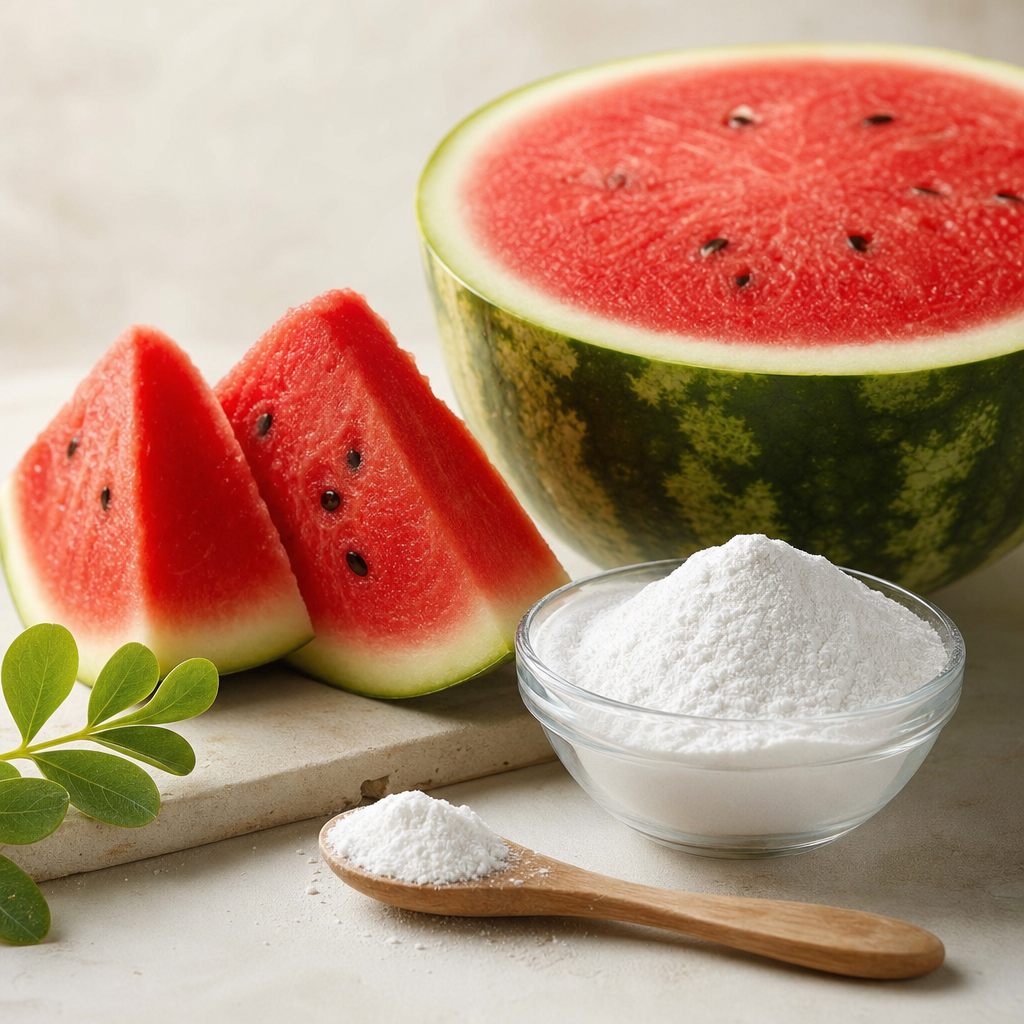
L- Citruline—more commonly spelled L-citrulline—is a non-proteinogenic amino acid found naturally in watermelon (Citrullus lanatus) and made in the human body as part of the urea cycle. In the kidneys, it is converted to L-arginine, which the body then uses to generate nitric oxide (NO), a signaling molecule that helps regulate blood vessel tone and blood flow. Because of this pathway, L- Citruline is widely used as a dietary supplement to support circulation and exercise performance.
Unlike vitamins and minerals, L- Citruline is not an essential nutrient; the body can produce it, and there is no established daily requirement. It is best described as a conditionally useful compound or supplement rather than a nutrient you must obtain from the diet. In sports and wellness contexts, it is valued for its ability to raise plasma arginine more effectively than taking arginine itself, primarily because citrulline bypasses extensive breakdown in the gut and liver.
Benefits of L- Citruline
-
Improves nitric oxide availability and blood flow
(Strong evidence)
L- Citruline consistently increases blood levels of arginine, which the body converts to nitric oxide. Human trials show improvements in measures of vascular function such as flow-mediated dilation and enhanced peripheral blood flow, especially in people with less-than-optimal endothelial function. This underlies many of the performance and wellness effects associated with citrulline.
-
Enhances high-intensity exercise performance
(Moderate evidence)
Supplementation can improve performance in time-to-exhaustion tests, cycling time trials, and repeated-sprint activities. Typical protocols use 6 g of L- Citruline or 6–8 g of citrulline malate taken 30–60 minutes before exercise. Results vary by sport, dose, and training status; benefits appear more consistently in high-intensity or anaerobic efforts than in long steady-state sessions.
-
May increase resistance-training volume and reduce perceived exertion
(Mixed evidence)
Some studies report more repetitions to failure, better training volume, and lower ratings of perceived exertion during upper-body sessions after citrulline malate, while others show little to no difference. Differences in malate ratios, dosing, and participant training history likely explain inconsistent findings.
-
Supports modest reductions in blood pressure
(Moderate evidence)
In adults with elevated or borderline-elevated blood pressure, daily L- Citruline has led to small but meaningful reductions in systolic and diastolic values over several weeks. Effects are generally modest and should be viewed as complementary to lifestyle measures, not as a replacement for medical care when indicated.
-
Assists erectile function in mild cases
(Limited to Moderate evidence)
By enhancing nitric oxide–mediated vasodilation, L- Citruline (for example, 1.5 g twice daily) has improved erectile function scores in small trials of men with mild symptoms. The effect tends to be modest, and responses vary. Individuals using prescription therapies should consult a clinician due to potential additive effects on blood pressure.
-
May reduce exercise-related ammonia accumulation and support recovery
(Limited evidence)
Citrulline participates in the urea cycle, which helps handle nitrogen waste. Some studies suggest lower blood ammonia and less fatigue during strenuous exercise, though findings are not uniform and more research is needed to confirm translation to performance or recovery outcomes.
-
Potential circulation support in older adults
(Preliminary evidence)
Early research indicates improvements in arterial function and walking-related performance markers among older adults after several weeks of supplementation. While promising, larger and longer trials are needed to determine consistency and clinical relevance.
Types or Forms Available
-
L- Citruline (free-form)
: The plain amino acid in powders or capsules. This is the most direct way to raise plasma citrulline and, subsequently, arginine. It contains 100% citrulline by weight and is easy to dose precisely.
-
Citrulline malate
: A combination of citrulline and malic acid. Two common ratios are 2:1 (two parts citrulline to one part malate) and 1:1. The 2:1 form delivers more citrulline per gram than 1:1. Some exercise studies have used citrulline malate, proposing that malate may aid energy metabolism, but head-to-head advantages over L- Citruline remain unclear.
-
Watermelon extract or juice powders
: Standardized for natural citrulline content. These provide a food-derived route but can vary in potency, making it harder to achieve research-like doses without consuming larger amounts.
-
Pre-workout blends
: Formulas that include L- Citruline or citrulline malate along with other ingredients (e.g., beta-alanine, caffeine). Potency and transparency vary widely; check labels for actual citrulline content and be mindful of stimulants if you want to avoid them.
-
Sustained-release tablets/capsules
: Less common and designed to release citrulline gradually. Potentially useful for daylong vascular support, though evidence comparing them to immediate-release forms is limited.
How to Use L- Citruline
Below are general guidelines drawn from human research and practical sports nutrition use. Individual needs can vary; start at the low end of the range and adjust with guidance from a qualified professional.
-
Common dosage range:
For exercise performance or “pump,” 3–6 g L- Citruline about 30–60 minutes before training is typical. If using citrulline malate (2:1), 6–8 g delivers roughly 4–5+ g of actual citrulline. For circulation or blood pressure support, many studies use 3–6 g per day, often split into 2 doses. For erectile support in mild cases, 1.5 g twice daily has been studied. Avoid very high intakes (e.g., above 10 g at once), which are more likely to cause stomach upset without clear additional benefit.
-
Best timing:
For workouts, take it 30–60 minutes pre-exercise. For daily vascular support, split morning and evening doses to maintain steadier blood levels.
-
How to take it:
Mix powder with water or a non-alcoholic beverage. It can be taken with or without food; a small snack may improve comfort for those prone to GI sensitivity.
-
Consistency:
Acute use can enhance exercise sessions, while daily use over several weeks may better support vascular function. Choose an approach based on your goals.
Food Sources and Supplement Options
L- Citruline occurs naturally in certain foods, with watermelon being the standout source. However, the amounts in typical servings vary and may be insufficient to reach the doses used in research without consuming large quantities. Supplements offer a more reliable and concentrated option when targeted dosing is desired.
-
Watermelon (flesh and especially rind)
-
Other gourds and melons (e.g., bitter melon, cucumber, pumpkin) contain smaller amounts
Whole foods provide additional nutrients, hydration, and phytonutrients that supplements lack, so a food-first foundation is still beneficial. Supplements make sense when you want predictable dosing for athletic performance, structured blood flow support, or when relying on food alone would be impractical. If choosing a supplement, look for products that disclose the exact amount of L- Citruline, specify citrulline malate ratios, and have third-party testing for quality.
Who May Benefit from L- Citruline?
-
Endurance and team-sport athletes seeking support for high-intensity intervals, sprints, or time trials
-
Recreational lifters and strength athletes aiming to increase training volume or reduce perceived exertion
-
Individuals who want nitric oxide support but experience GI discomfort with arginine or prefer citrulline’s more reliable arginine boost
-
Adults with borderline-elevated blood pressure or suboptimal vascular function who are already working on diet, activity, sleep, and stress management and want a supplemental adjunct, ideally with clinician guidance
-
Older adults interested in circulation support and walking performance, after discussing with a healthcare professional
-
Men with mild, occasional erectile difficulties who are not on interacting medications and who have consulted a clinician
Side Effects and Considerations
-
Gastrointestinal discomfort:
Higher single doses may cause nausea, stomach cramping, or diarrhea. Starting low (e.g., 1–2 g) and splitting doses can improve tolerance.
-
Blood pressure effects:
Because L- Citruline can promote vasodilation, it may lower blood pressure slightly. People with low blood pressure or those prone to dizziness should be cautious.
-
Medication interactions:
Possible additive effects with antihypertensives, nitrates (e.g., for chest pain), and PDE-5 inhibitors (e.g., sildenafil). Combining can lead to excessive blood pressure drops. Consult a clinician before use.
-
Kidney and liver considerations:
The kidneys convert citrulline to arginine; altered kidney function may change responses. People with kidney or significant liver disease should seek medical advice before using.
-
Surgery and acute illness:
Stop use 1–2 weeks before elective surgery and avoid starting new vasodilatory supplements during acute illness unless advised by a clinician.
-
Pregnancy and breastfeeding:
Safety data are limited. Pregnant or breastfeeding individuals should consult a healthcare professional before use.
-
Children and adolescents:
Not generally recommended for performance enhancement in minors without medical supervision.
-
Allergies and sensitivities:
Those with watermelon or melon allergies should avoid food-based sources and carefully evaluate supplements. Some products may contain flavorings, colorants, or be manufactured with common allergens.
-
Product quality and labeling:
Citrulline malate ratios (2:1 vs 1:1) change how much citrulline you get. Choose brands with transparent labels and third-party testing to minimize contamination risk and ensure dose accuracy.
-
Combination products:
Many pre-workouts include stimulants. If you are sensitive to caffeine or prefer stimulant-free options, select pure L- Citruline or stimulant-free blends.
Common Myths About L- Citruline
-
Myth: L- Citruline is the same as L-arginine.
While related, they are not the same. L- Citruline often raises blood arginine more effectively than taking arginine directly because arginine is more extensively broken down in the gut and liver. Citrulline bypasses that first-pass breakdown and is converted to arginine in the kidneys.
-
Myth: If a little helps, more is always better.
Doses above common research ranges do not reliably add benefits and are more likely to cause stomach upset. Most performance protocols use 3–6 g L- Citruline or 6–8 g citrulline malate (2:1) pre-exercise. Extremely high single doses are unnecessary and can be uncomfortable.
-
Myth: A big “pump” guarantees muscle growth and strength gains.
The pump reflects transient blood flow, not long-term hypertrophy or strength by itself. Some trials show improved training volume, but results vary. Progress still depends on well-designed programming, nutrition, sleep, and recovery.
-
Myth: Natural supplements are automatically safe with all medications.
L- Citruline can influence blood pressure and may interact with medications like nitrates, PDE-5 inhibitors, and antihypertensives. Medical guidance is important if you take prescription drugs or manage a health condition.
-
Myth: L- Citruline is banned in sports.
L- Citruline is not on common anti-doping prohibited lists. Still, athletes should choose third-party–tested products to avoid inadvertent contamination with banned substances.
Conclusion
L- Citruline is a non-essential amino acid supplement that reliably raises arginine and supports nitric oxide production. This can translate to better blood flow, helpful effects on high-intensity exercise, and small reductions in blood pressure for some individuals. It may also offer modest help with resistance-training volume and erectile function in mild cases, though responses vary. For athletic purposes, 3–6 g of L- Citruline or 6–8 g of citrulline malate (2:1) taken 30–60 minutes before training is a common approach; for circulation support, split daily dosing is often used.
Choose high-quality, transparently labeled products and be cautious if you take medications that affect blood pressure or if you have kidney, liver, or cardiovascular conditions. Pregnant or breastfeeding individuals, children, and anyone on prescription therapies should consult a healthcare professional before use. Whole foods—especially watermelon—contribute naturally occurring citrulline and other nutrients, but supplements provide precise, research-aligned dosing when that is the goal. Used thoughtfully alongside sound training, nutrition, sleep, and stress management, L- Citruline can be a practical tool for select performance and wellness objectives.